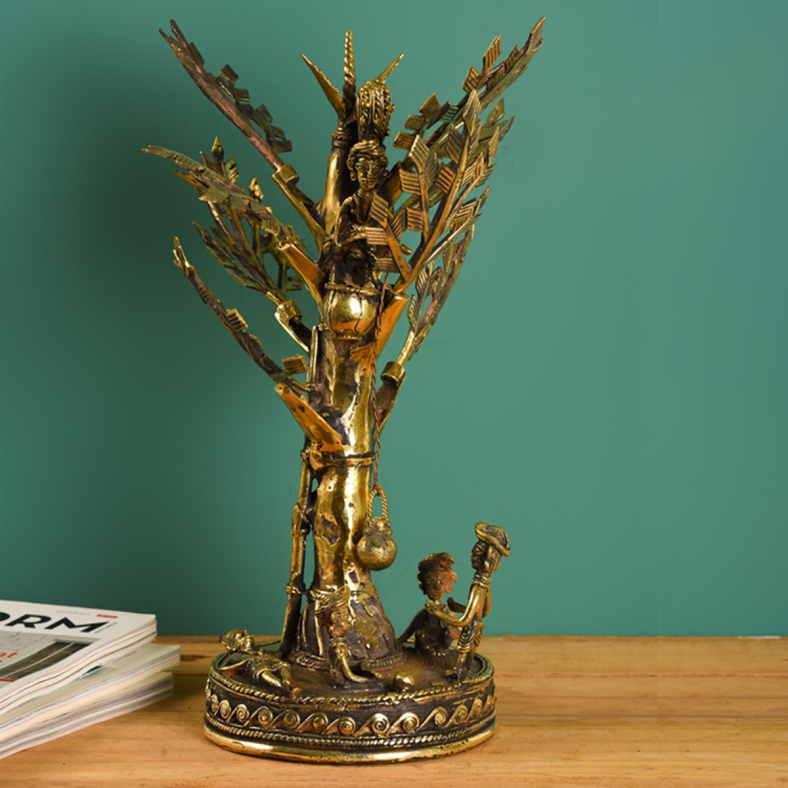
The Dhokra Salfi Tree stands on a round, elaborated base, its trunk branching out into flat feathered leaves, and among them a figure climbs, arms encircling the bark high in the canopy. A rounded pot hangs from the trunk below, and at ground level a second figure sits with a vessel raised in both hands, the two connected across the height of the piece. Every leaf is cut and grooved, and the base is banded with spirals and rope borders. Finished in a warm gold tone, this Dhokra sculpture captures an entire scene of village life in one standing form.
Height and openness make this the toughest kind of casting in the craft. Dhokra artisans raise the trunk by coiling hair fine wax threads over a clay core, then build each branch and every feathered leaf individually, adding the climbing figure, the hanging pot, and the seated companion before the entire tree takes a single continuous pour. So slender a structure has to fill completely and hold its shape, and the mould is broken open once and never used again. That means every one of these Dhokra handicrafts turns out a little different, and a piece this ambitious is traditional craftsmanship at full stretch, far beyond anything you see on the shelves of most craft stores.
At this height it acts as a centrepiece rather than an accent. Place it on a console, a sideboard, a wide shelf, or a corner table so the branches can fan out and the climbing figure can be seen across the room. The eye is drawn upward, filling vertical space that furniture seldom reaches, and its openwork canopy keeps it airy despite the scale. It looks majestic among your Dhokra figurines and traditional handicrafts, yet it holds a room comfortably on its own. If you are shopping through handicrafts online for a real showpiece, this is one of the most remarkable Dhokra art products to bring home.
There is something moving about a scene of daily work rendered with such care, a person up a tree, another waiting below, ordinary life given the scale of sculpture, and that carries this piece well past craft decorations into a true conversation starter. It fits well in a living room, an entrance hall, a study, or a home that already holds handicraft products collected over the years, and it makes a great gift for a collector, an art lover, or someone celebrating a milestone. A light dusting lets the gold tone glow through the leaves, and asking for almost nothing in return, this Dhokra artifact remains striking for years, a real piece of heritage craft standing tall in your space.
Work a dry, soft brush carefully through the fronds and around the figures at intervals, since dust settles quickly across the many open branches
If the gold loses its brightness, pass a dry cotton cloth over the trunk and base with a light hand, and use a soft brush rather than cloth around the delicate leaves
Stand the tree somewhere dry with air moving freely, well away from washrooms, kitchen steam, and clammy walls that draw the shine out of brass
For a proper clean, use a soft toothbrush with a mild tamarind or lemon dab, ease it through the fronds and figures, rinse quickly, and dry every branch fully
Keep wire bristles, coarse pads, and harsh chemical cleaners away entirely, as the thin fronds bend easily and mark under pressure
After it dries right through, brush on a fine coat of clear lacquer to guard the intricate surface and slow natural darkening
Always lift the piece by its round base rather than the trunk, branches, or figures, and give it a spot where it will not be knocked in passing
Product Information
Dhokra Salfi Tree 5.5" W x 9.5" D x 13" H
Finish detail: A bright gold across the trunk and figures with softer shading in the fronds and recesses, the honest look of hand poured metal
Conversation piece: Its narrative detail and unusual height make it the sort of object guests stop to look at closely
Village scene: A climber gathers sap from the tree while two figures rest below, capturing a working moment from Bastar life rather than a static form
Tall spreading tree: Feathered fronds fan out in every direction from a central trunk, giving the piece real height and an open, airy outline
Multiple figures: Three separate figures are worked into the composition, each with its own posture, tools, and expression

 Whatsapp
 Facebook
 Messenger
 Telegram
 Twitter
 LinkedIn