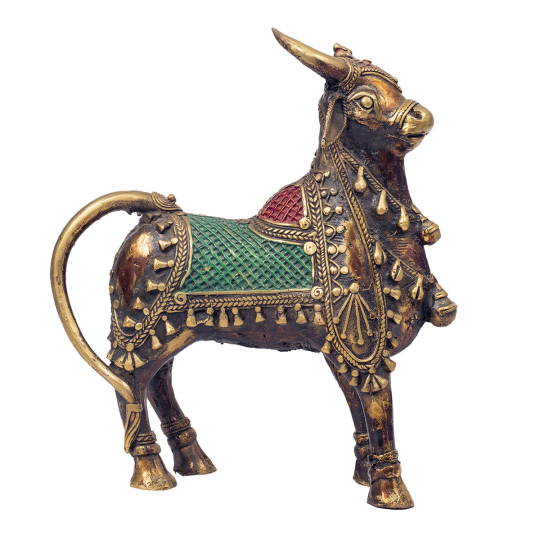
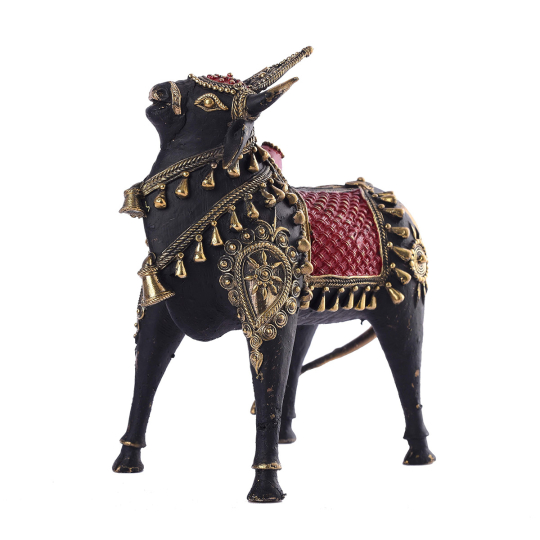
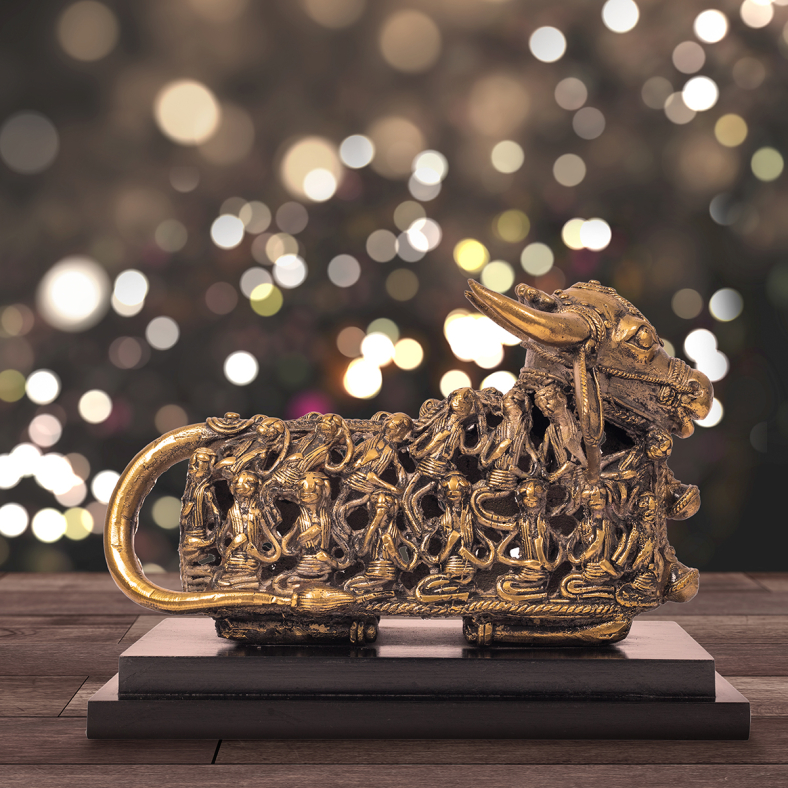
The Dhokra Lyden Nandi is a reclining ornamental bull, its long body lying low on a dark wooden base while its head lifts and turns back over the shoulder. Unlike the upright figures in this range, its real interest lies in the body itself: not a solid form, but a dense openwork lattice of tiny sculpted figures, each one seated and detailed, packed together to make up the animal's shape. Cast in brass and finished in a warm gold tone, the piece rewards a slow, close look, as new little figures keep revealing themselves the longer you study it.
This is one of the more ambitious forms in the craft, and it shows exactly what this Dhokra art figurine tradition is capable of. Working in the lost wax casting method, an artisan shapes every miniature figure in wax over a clay core, arranging the whole crowd by hand before the entire sculpture is cast in one continuous pour and freed from a mould that is broken open once and never used again. That degree of openwork, dozens of tiny forms joined together as a single body, is immensely difficult, and it is what separates genuinely ambitious handmade brass figurines from more straightforward cast pieces. The curved tail loops down to the base, completing the composition with an elegant sweep.
Raised on its own wooden stand, this reclining bull is made to be a centrepiece. It commands a console, a curio cabinet, a sideboard, or a low display table in the living room, where its intricate figural work can be seen in the round. Standing as the clear focal point among your other decorative statues and collectible figurines, it easily leads any grouping of animal figurines. For collectors of folk craft, ethnic decor, and handmade home decor with real artistic depth, this is the kind of showpiece that anchors an entire display.
This figure carries a rare storytelling richness that takes it well past ordinary home decor items and into serious collector territory. It looks right at home on a gallery shelf, in a formal living room, or in a study where a discerning eye can appreciate its complexity, and it makes a remarkable gift for a lover of handcrafted art or someone celebrating a milestone. A light dusting is all it takes to keep the gold finish and the detailing bright, and with proper handling these home decor statues hold their rich, layered look for years to come, a true piece of handcrafted heritage that becomes a lasting conversation starter in your space.
Dust the openwork body gently with a soft, dry brush, reaching between the little figures where particles tend to collect in the gaps
When the golden shine dims, work a dry cotton or microfibre cloth lightly over the raised areas to coax the warmth back without forcing the cloth into tight spaces
Keep the piece in a dry, ventilated place away from moisture and steam, which settle easily into the many recesses and speed up dulling
For deeper cleaning, use a soft toothbrush with a mild lemon and salt dab, work carefully through the figures, then rinse briefly and dry every gap fully
Avoid abrasive pads, wire brushes, and strong chemicals, since the fine openwork is fragile and marks easily
Once dry, mist or brush on a thin coat of clear lacquer to protect the intricate surface and slow natural tarnish
Wipe the wooden base separately with a barely damp cloth, dry it quickly, and always lift the piece by its solid sections rather than the delicate figures
Product Information
Dhokra Lyden Nandi 12" W x 6" D x 9" H
Finish: Wears a glowing golden lustre with soft dark shading in the recesses, giving the figure texture and an artisanal depth
Distinctive design: The bull's form is built from rows of small interlinked human figures, an inventive and rarely seen composition that sets this piece apart
Openwork build: Gaps between the figures create a see through, lacelike body that lets light pass through and shows off the depth of the casting
Wooden stand: Set on a dark, flat wooden base that steadies the piece and frames it for a refined tabletop display
Fine detail: Each miniature figure carries its own posture and shaping, so the whole body reveals more the longer you study it

 Whatsapp
 Facebook
 Messenger
 Telegram
 Twitter
 LinkedIn